


The ROI of better care
See the Real-World Impact of Measurement-Based Care.
Quickly estimate how Greenspace can improve outcomes, reduce costs, and increase member engagement accross your organisation
Quickly estimate how Greenspace can improve outcomes, reduce costs, and increase member engagement accross your organisation

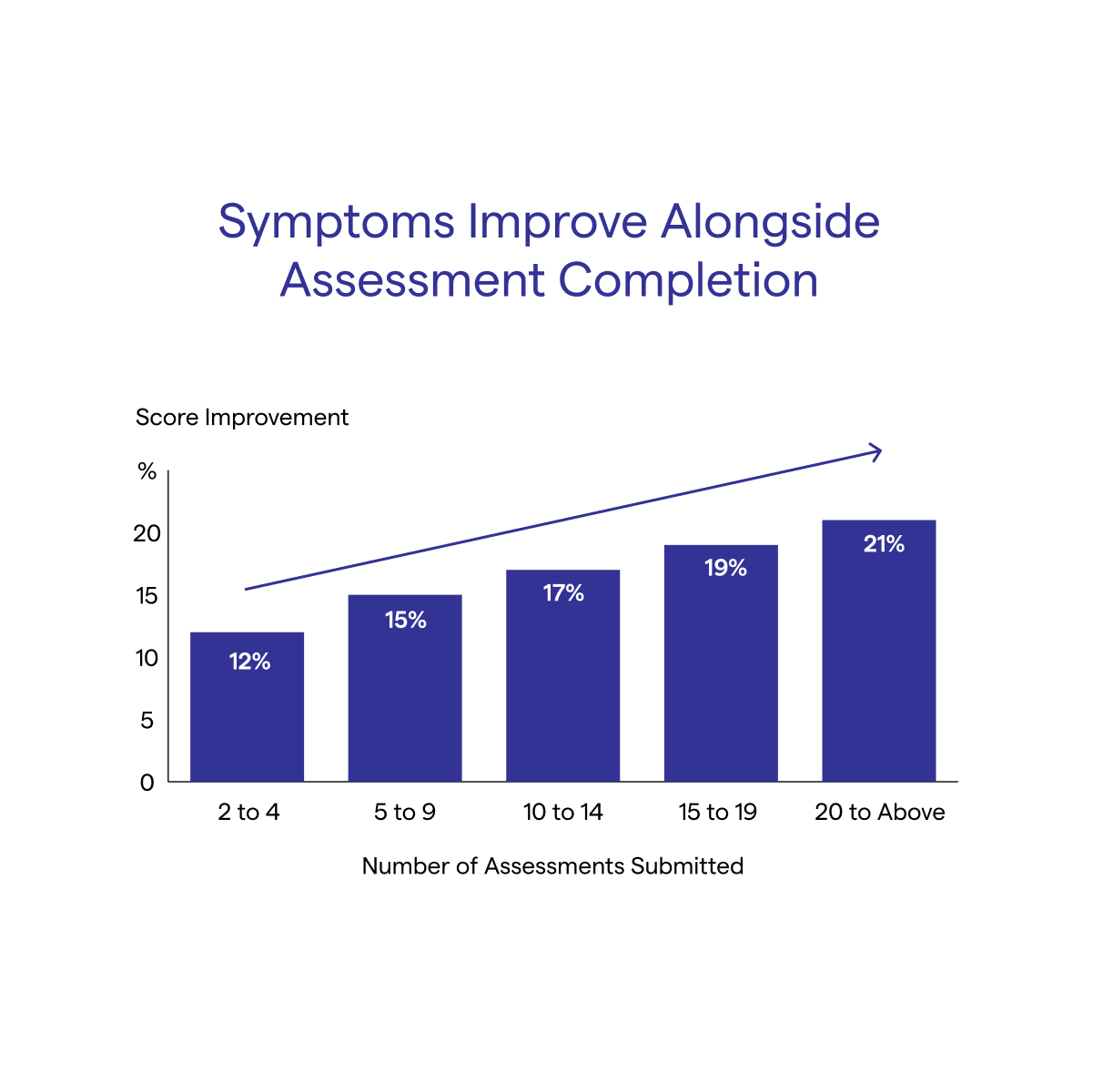
People accessing the resource hub can track their progress by completing a mental wellness self-assessment at their chosen frequency (default frequency is set to every two weeks). They can choose to receive a notification to complete the assessment every week, two weeks, four weeks or eight weeks. Assessment frequency can also be configured based on organization and user preferences or best practices.
Across our Population Health Hub implementations, usage and outcome data shows that regular self-assessments help to drastically enhance continued mental health engagement and symptom improvement. The average 30-day user retention rate across our Hubs is 43%, which is very promising, especially when compared to the industry average for self-guided mental health tools of between 3-6%. As well, those who return to specifically complete their self-assessments account for 93% of returning users.
It is clear that users return to the Hub in order to complete their self assessments, which helps users stay engaged in preventative care. Additionally, assessment engagement also correlates to overall symptom improvement. Our outcome-data, from over 250,000 users, shows that the more assessments a person completes, the more their wellness improves over time.
The Population Health Hub presents non-diagnostic mental health data to users, alongside unique insights and prompting questions that help encourage users to reflect on their symptom changes that have occurred since their last assessment. The goal is to spark their curiosity about changes in their results to help them gain a better understanding of their mental health, including what things in their life may be impacting them positively or negatively.
The Hub also recommends resources based on a user’s most recent assessment results. Regular assessment completion helps users understand when a resource is, or is not, working for them and when they may need to step up to a higher level of care (e.g. 1:1 therapy).
Your Population Health Hub will be tailored to your organizations specific implementation. There are three ways in which data can be shared with providers, dependent on your implementation:
The Hub is accessible via mobile, tablet, or desktop browser and has been optimized to provide a seamless experience across all settings. Greenspace Population Health Hubs also offers the option for a mobile application that can be leveraged to increase Hub accessibility and provide an option for further engagement from your Hubs most active users.
Security of patient information and privacy is the foundation of the Greenspace platform. We take this responsibility very seriously and have implemented significant measures to safeguard patients’ personal health information that exceed industry standards and best practices. Greenspace is SOC 2 Type II compliant and conforms to digital and physical security protocols (including HIPAA), with SSL-secured access, AES encryption at the filesystem level, and firewalls protecting all data. We take many additional precautions to protect privacy including: requiring strong passwords, automatic logouts, automatic access logging, secured data backups, two factor authentication and restrictive data access procedures. All data and information is stored in the US. Please review our Security Page for more details.
The information users provide on this site belongs to them and is kept private and confidential. Unless otherwise agreed to by the user for research or clinical purposes, personal information will not be shared, sold, or disclosed to third parties, as described in our Privacy Policy. You can read our full privacy policy here.
The assessments that are delivered to users (via browser, by email or SMS) don’t contain any personally identifying information or health information. When assessments are completed, the data is sent to the application’s server through secure channels (HTTPS, SSH, etc.). No user information in conjunction with user names is ever sent over unsecured email or other unsecured channels.
Speak with our team to find out how Greenspace can help positively impact patient outcomes.
Privacy and security are the foundation of everything we do.



Speak with our team to find out how Greenspace can help positively impact patient outcomes.
Privacy and security are the foundation of everything we do.
Privacy and security are the foundation of everything we do.